For your partiesFor construction
Construction Site Toilet Requirements in Illinois: OSHA Rules Explained
What OSHA requires on a job site, in plain English, plus what actually keeps a crew happy.
If you run a crew in Lake County, you need restrooms on site. That is not just good practice, it is a federal rule. This guide explains what the OSHA construction standard says about toilets, how the worker ratios work, and the practical things that keep a job site restroom from turning into a problem. It is written for general contractors, builders, roofers, landscapers and anyone else putting a crew to work in Waukegan, Zion, Gurnee and the rest of Lake County.
The rule: OSHA 1926.51
Toilets on construction sites are covered by the federal OSHA construction standard, 29 CFR 1926.51, in the part on sanitation. Illinois private-sector employers fall under federal OSHA, so this is the rule that applies to most crews in Lake County. The rule says employers must provide toilets for employees, and it gives a minimum number based on crew size.
| Number of employees | Minimum number of facilities |
|---|---|
| 20 or fewer | 1 toilet |
| 20 or more | 1 toilet seat and 1 urinal per 40 workers |
| 200 or more | 1 toilet seat and 1 urinal per 50 workers |
This table is the legal minimum. It is not a promise that one unit will stay clean for 40 people all week. In practice, most contractors plan on more capacity, which we explain below.
This guide is general information, not legal advice. Rules can change, so check the current standard at osha.gov or with your safety officer if you are unsure.
What counts as a toilet facility
The standard says that on job sites without a sanitary sewer, employers must provide one of the following, unless local codes say otherwise:
- Chemical toilets, which is what a standard portable toilet is
- Recirculating toilets
- Combustion toilets
- Flush toilets
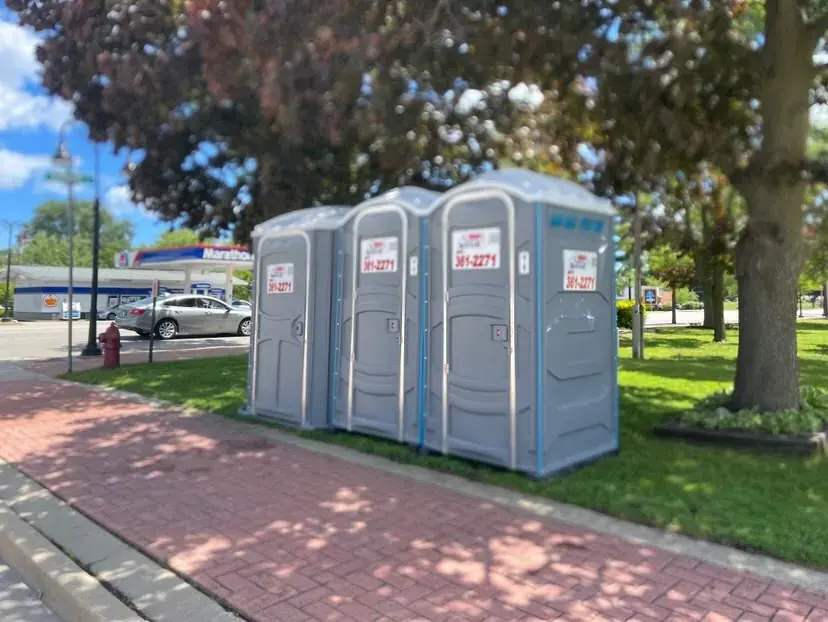
For nearly every new build, remodel or site job in Lake County, that means portable toilets. Our standard portable toilets are chemical toilets with a vented holding tank and a urinal, which matches what the table asks for in a single unit.
There is one exception worth knowing. The requirement does not apply to mobile crews that have transportation readily available to nearby toilet facilities. A two-person crew driving between short service calls is different from a crew working at one site all day.
Hand washing on job sites
OSHA also requires washing facilities on construction sites when they are needed to keep workers healthy, especially for crews working with paints, coatings, herbicides, insecticides or other contaminants. Those facilities need to be close to where the work happens and stocked with water, soap and a way to dry hands.
Whether a hand wash setup is needed depends on the work. Concrete, painting, roofing with sealants and demolition crews usually need one. Ask us what we can set up for your site when you call.
The legal minimum versus what crews actually need
The OSHA table lets one toilet cover up to 20 workers. Anyone who has managed a crew knows a single unit shared by 20 people, serviced once a week, gets ugly by Thursday. That is why the planning number most companies use, including us, is one unit per 10 workers on a 40-hour week with weekly service.
| Crew size | OSHA minimum | What we recommend (weekly service) |
|---|---|---|
| 5 | 1 | 1 |
| 15 | 1 | 2 |
| 25 | 1 seat + 1 urinal | 3 |
| 40 | 1 seat + 1 urinal | 4 |
| 60 | 2 seats + 2 urinals | 6 |
Clean, available restrooms are not just about rules. Crews that have to wait or walk across a large site lose time. A clean unit also matters to the homeowner or property manager who sees it every day. Our porta potty planning chart covers more sizes.
Where to put units on a job site
- Close to the work. A unit at the far end of a big lot means long walks. On large sites, split units into two locations.
- Reachable by our truck. Our service truck needs to get within about 25 feet with a clear line for the hose. A unit blocked by material or equipment cannot be serviced.
- On level ground. A tipped unit is a mess no one wants. Gravel, pavement or packed dirt works best.
- Away from traffic. Keep units clear of where trucks back up and where cranes swing.
- Lit for early starts. In fall and winter, Lake County crews often start before sunrise. Put units where site lighting reaches them.
As the job moves, units can move too. Tell us when you need a unit relocated and we will plan it into a service visit.
Service schedules that keep you compliant
A unit that is full or out of paper does not really count as a working toilet. Most job sites do well on weekly service. Busy sites, hot weeks and big crews may need twice-weekly visits. Every service visit includes pumping the tank, recharging the deodorizer, restocking paper and wiping down the inside. Read more on our cleaning and pumping service page and in our guide to service frequency.
Working through the cold months? See our winter porta potty guide for what changes when temperatures drop.
Common job site restroom mistakes
- One unit for the whole job, no matter the crew size. Crews grow during framing and finish work. Add units when the crew does.
- Placing the unit where it blocks the work. It ends up moved by hand, tipped or buried behind material. Pick a spot that stays clear for the whole job.
- Forgetting about service access. A unit behind a fence, a dumpster or a stack of lumber cannot be serviced.
- Not telling the rental company when the job ends. Units left on a finished site keep billing. Call as soon as you know your end date.
- Skipping hand washing on dirty work. Painting, coatings and demolition crews need a way to wash up.
Construction toilet rental across Lake County
We deliver construction site toilets to builders and contractors across Lake County, including construction sites in Waukegan, job sites in North Chicago, Gurnee builds and Zion projects. Jobs that run a month or longer go on our long-term rental with a standing service day.
Call (847) 361-2271 with your crew size, address and start date, and we will tell you how many units you need to stay covered.
Common questions
How many toilets does OSHA require on a construction site?
For 20 or fewer workers, at least one toilet. For 20 or more, one toilet seat and one urinal per 40 workers. For 200 or more, one seat and one urinal per 50 workers.
Does OSHA require porta potties on residential job sites?
The construction standard applies to employers with employees on site, including residential work. Mobile crews with quick access to nearby restrooms are an exception.
Do construction sites need hand washing stations?
OSHA requires washing facilities when needed to keep workers healthy, especially for crews working with paints, coatings or other contaminants. Ask us what we can set up.
How often should a job site porta potty be serviced?
Weekly service is standard for most crews. Large crews, hot weather or tight sites may need twice-weekly service.
Is the OSHA minimum enough?
It is the legal minimum. Most contractors plan on one unit per 10 workers with weekly service so the units stay usable all week.
Do you deliver construction toilets in Waukegan?
Yes. We deliver and service construction site toilets in Waukegan and across Lake County. Call (847) 361-2271.
Keep planning
Services, towns and other guides that go with this one.
Our services
Towns we serve
For your partiesFor construction
Need clean restrooms on site?
Tell us your dates, your location and how many units you need. We deliver across Lake County and keep every unit on a service schedule.